

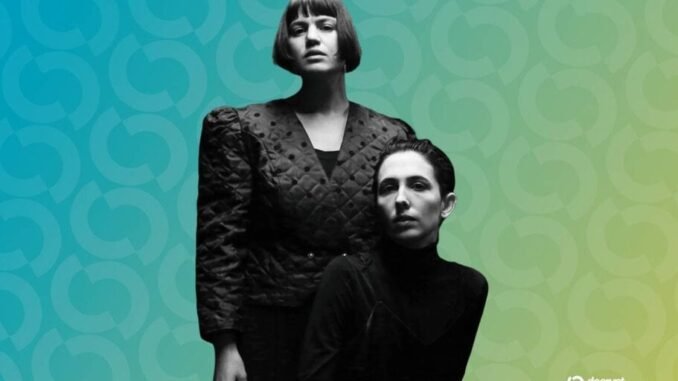

NFTs have provided digital artists with new ways to monetize their work by introducing scarcity to the market, but other creative fields can also benefit, performance art duo Operator told Decrypt.
The performing arts have a “similar issue” to digital artists, explained Ania Catherine, who works with collaborator Dejha Ti as Operator. Prior to the advent of NFTs, Catherine said, “Digital artists were in a position of being in a service industry, working for advertising firms, the film industry, for entertainment—and then they would have their digital art on the side.”
Performance artists are in an even more challenging position thanks to the ephemeral nature of their work, she said. “You have an expensive medium to work in performance, because you need body, time, space, people, dancers—and in the end, there’s kind of nothing to sell.”
That’s historically limited performance artists to “dancing in commercials, teaching dance, or going on tour and dancing behind a musician,” in order to pay the bills, Catherine explained.
Collecting movement
NFTs change the game by enabling performance artists to create permanent, collectible pieces. “What does it look like if someone can own movement as an art object?” she said. That, in turn, enables “a form of patronage of people who use movement as an art form, who don’t want to use it for entertainment, but as real personal expression. How can we create an infrastructure where that can be actually monetized?”
Operator has applied that thinking to its artwork “Human Unreadable,” a three-act piece combining choreography, generative art, blockchain and cryptography that builds to a live performance to be presented at the end of 2026.
“What we felt when we first started diving into crypto art was we were missing the presence of the human body,” Catherine said, adding that, “Early on, we could scroll through platforms for 20, 30 pages and never see the human form.”
Accordingly, Human Unreadable places the human form “at the core” of the artwork, with each of the 400 pieces in the collection representing an “underlying unique dance” generated by an algorithm. The work draws on computational choreography’s “rich and interesting history,” stretching back to the earliest digital art exhibitions at the ICA in 1967, she explained.
Storing human movement data on the Ethereum blockchain also presented its own set of challenges, she added. “We definitely felt that we were not supposed to be using blockchain and Art Blocks in this way,” she said, but were “a little delusional enough” to push through the roadblocks of a technology that was “not meant to communicate the body and dance.”
The end result explores and interrogates the technology behind generative art, she explained. “In the way that something can be spatially site-specific, or location-wise, site-specific, Human Unreadable is site-specific to long form, on-chain generative art.”
Operator’s perseverance has paid off, with Human Unreadable scooping the Experiential Award at the recent Digital Art Awards. It joins a brace of gongs on their shelf that includes two Lumen Prizes, a S+T+ARTS Prize and an ADC Award—“which are technically design awards,” Catherine said, “but we’ve won them for experiential design and things.”
Beyond the market
And while the NFT art market may be in the doldrums, with trading volumes crashing from a $2.9 billion high in 2021 to just $23.8 million in the first quarter of 2025, artists are still keen to explore the possibilities of the underlying technology, Catherine said.
“Artists don’t create for a market,” she told Decrypt. “They create because they have a curiosity or a question or a drive, or something hits them that just needs to come out.”
And while it’s still important for artists to “make money from the value that they’re bringing to the world through their craft,” she said, it shouldn’t be a surprise that they continue to push the boundaries. “Most artists don’t do it for the money or for the market. They often do it despite the bad conditions of those things,” she said. “Artists are always going to make art.”
Edited by Andrew Hayward
Daily Debrief Newsletter
Start every day with the top news stories right now, plus original features, a podcast, videos and more.



Be the first to comment